

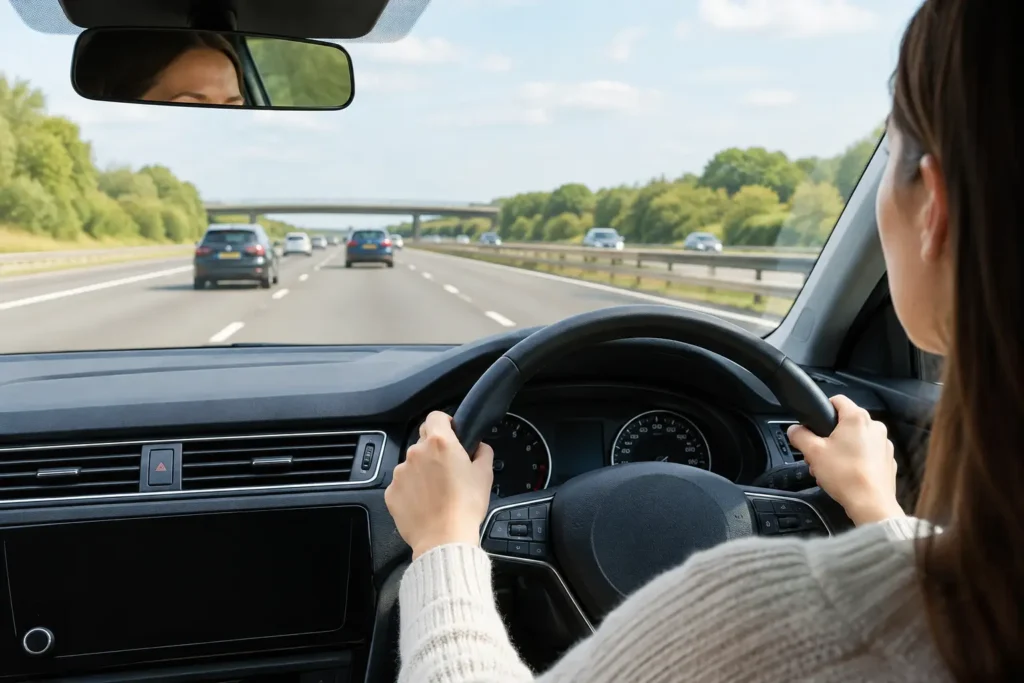
A motorway can feel like a major step up from the roads you used while learning. Faster traffic, larger vehicles and several lanes demand more forward planning, but they do not need to be intimidating. This motorway driving guide explains the habits that help new drivers travel safely, calmly and confidently.
Before your first motorway journey
Do not make your first motorway drive an important journey with a tight deadline. Choose a quieter time, plan a short route and make sure you know which junction you need before setting off. A sat nav can be useful, but it should support your observations, not replace them. Listen for instructions early and check road signs regularly.
Before joining, check your fuel level, tyres, lights and screenwash. Motorway driving gives you fewer safe opportunities to stop if something is wrong. It is also sensible to take breaks on longer journeys. Tiredness affects concentration and reaction time, particularly on a long, repetitive stretch of road.
Learner drivers may drive on motorways in England, Scotland and Wales, but only with an approved driving instructor in a dual-controlled car. This can be an excellent way to gain experience in a controlled setting before driving independently. Motorway driving is not assessed as part of the practical driving test, so extra tuition or Pass Plus training can give you valuable confidence after passing.
Joining safely and building speed
The slip road is there to help you match the speed of traffic already on the motorway. Use it. Check your mirrors early, assess the gaps in the left-hand lane and build speed progressively where it is safe to do so. Drivers already on the motorway have priority, so you must give way when joining.
Avoid stopping at the end of a slip road unless there is no safe alternative. Pulling away from a standstill into fast-moving traffic is much harder and can create a risk for everyone. At the same time, do not force another driver to brake or swerve to make room for you. A calm, early decision is safer than a last-second move.
Traffic on the motorway may move right to create space for joining vehicles, but never assume it will. Keep looking well ahead as you join, then settle into the left-hand lane once you are safely on the carriageway.
Keep a safe gap
At motorway speeds, the space in front of you is one of your most important safety tools. In dry conditions, use the two-second rule: choose a fixed point ahead, such as a bridge or sign, and make sure it takes at least two seconds from the vehicle ahead passing it to you reaching it.
Double this gap in wet weather. On icy roads, allow up to ten times the normal gap and consider whether the journey is necessary at all. Heavy rain, spray, fog and low sun can all make it harder to see hazards developing. Slowing down and leaving more room is not hesitant driving. It is sensible driving.
Lane discipline: keep left unless overtaking
The basic rule is straightforward: drive in the left-hand lane whenever it is clear and safe. Use the lanes to your right to overtake, then return left when you have passed. Staying in a middle or outside lane when the lane to your left is clear can obstruct other traffic and may lead to careless driving penalties.
Before changing lanes, use the mirror-signal-manoeuvre routine. Check your interior mirror, then the relevant door mirror. Signal in good time, check again, and move only when there is a suitable gap. Remember that vehicles can sit in blind spots, especially motorcycles and smaller cars. A quick shoulder check may help where appropriate, but keep your main attention on the road ahead.
Do not weave through traffic to make progress. The small amount of time saved is rarely worth the risk. If you miss an exit, continue to the next junction and turn around safely. Stopping, reversing or making a sudden lane change to recover a missed turn is dangerous and illegal.
Overtaking lorries and other large vehicles
Give lorries, coaches and other large vehicles extra space. Their drivers have bigger blind spots and need more room to stop or manoeuvre. When overtaking, pass decisively without speeding, avoid sitting alongside them, and do not pull back in too closely.
In strong crosswinds, a large vehicle can also affect your car as you pass. Keep both hands on the steering wheel and expect a slight change in airflow. If you are unsure about an overtake, wait. There will be another safe opportunity.
Speed limits, signs and smart motorways
For most cars, the national speed limit on a motorway is 70 mph, but this is a maximum, not a target. Your safe speed depends on traffic, weather, visibility, road surface and your vehicle. Roadworks often have lower limits, and average-speed cameras are common. Settle at a legal, manageable speed rather than feeling pressured to keep pace with the quickest traffic.
On smart motorways, overhead signs and lane signals are legally enforceable. A red X means that lane is closed. Never drive beneath a red X, even if the lane looks empty. It may be closed because of a stopped vehicle, emergency services or a hazard that you cannot yet see.
Variable speed limits are used to manage congestion and reduce sudden braking. Reduce your speed smoothly when a lower limit appears, rather than braking sharply at the last moment. Keep a close eye on signs, particularly in busy conditions where traffic can change quickly.
What to do if traffic stops suddenly
Motorway traffic can slow from 70 mph to a standstill with little warning. Look far ahead, not only at the rear of the vehicle in front. Brake progressively, check your mirrors and use your hazard warning lights briefly if you are braking sharply or approaching a queue that drivers behind may not have seen.
Leave enough room to the vehicle in front so that you can move away without reversing if needed. In very slow traffic, remain patient and avoid changing lanes repeatedly. Queue-jumping often creates more uncertainty, not more progress.
If you are approaching roadworks or a lane closure, move into the correct lane early when signs direct you to do so. Late merging is not confident driving. It is a common cause of sudden braking and sideswipes.
If you break down on a motorway
A breakdown is stressful, but your priority is to get yourself and any passengers to the safest available place. If your vehicle is still moving, leave at the next exit or pull into a motorway service area if you can do so safely. On a smart motorway, use an emergency area where possible.
If you have to stop in an emergency, switch on your hazard warning lights. Follow the instructions displayed on signs where available and contact the emergency services or your breakdown provider when it is safe. If you can leave the vehicle safely, move away from traffic and behind a safety barrier where one is present. Do not attempt repairs at the roadside, and do not place a warning triangle on a motorway.
On a live lane, the safest action depends on the exact situation. Stay alert to instructions from emergency services, use an emergency phone if one is nearby and safe to reach, and give your precise location if you call for help. Motorway marker posts, emergency-area signs and junction numbers can help identify where you are.
Build confidence with proper motorway training
Confidence comes from good decisions repeated consistently, not from driving fast or taking chances. A qualified instructor can help you practise joining, lane changes, overtaking, reading signs and managing busy traffic without unnecessary pressure. It also gives you the chance to ask questions about situations that can feel difficult when you are driving alone for the first time.
English School of Motoring offers structured advanced training to help drivers develop safe habits for life, with patient one-to-one support and clear progress guidance. Whether you have recently passed or simply want to feel more settled on faster roads, extra experience can be a worthwhile investment in your safety.
Your first few motorway journeys do not have to be perfect. Plan well, leave space, stay observant and give yourself permission to take the next safe opportunity rather than rushing a decision.