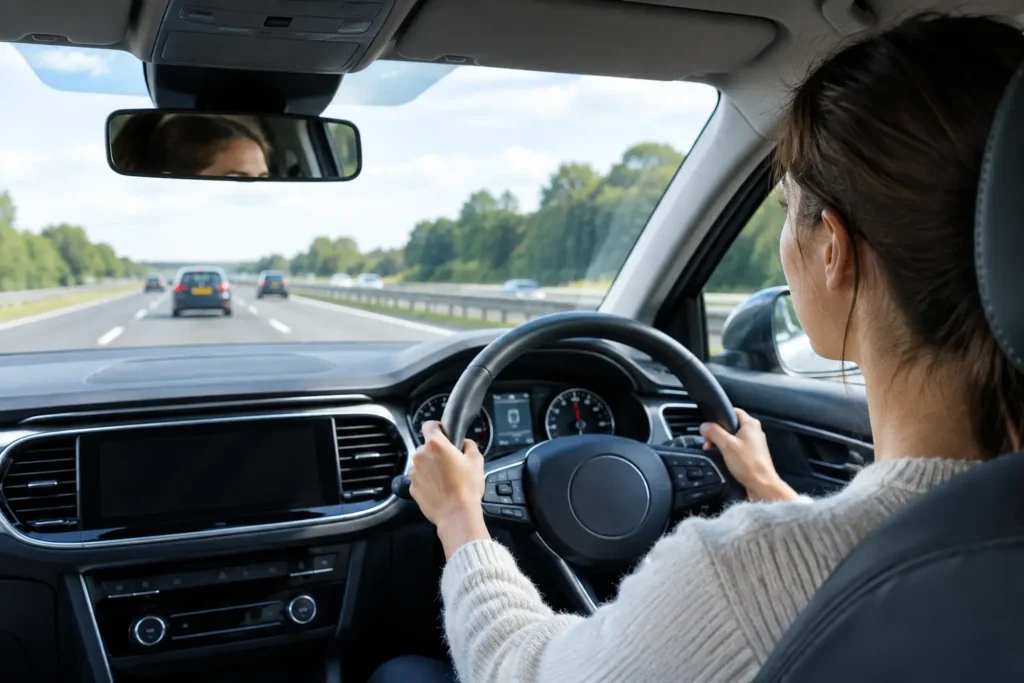
For many pupils, joining a motorway feels like the moment driving becomes properly serious. So, can learners drive motorways? Yes – but only in specific circumstances. Since 2018, learner drivers in England, Scotland and Wales have been allowed on motorways when they are with an approved driving instructor in a dual-controlled car.
That does not mean every learner should head straight for the nearest slip road. Motorway lessons work best when you have already built sound judgement on ordinary roads and are ready to manage higher speeds without rushing your decisions. Done at the right time, they can replace nerves with useful, lasting confidence.
Can learners drive motorways with family or friends?
No. A learner cannot drive on a motorway with a parent, friend or any other qualified driver, even if that person has held a full licence for years. The supervising instructor must be an Approved Driving Instructor (ADI), and the car must have dual controls.
These rules exist for good reason. Motorways bring faster traffic, shorter decision-making windows and more complex lane choices. An ADI can guide you through a situation as it develops and, where necessary, use the dual controls to help keep the car safe.
Learner drivers must still display L plates. The usual requirements also remain in place: you need a valid provisional licence, suitable insurance and a roadworthy vehicle. Motorway driving is not included in the practical driving test, but the skills involved matter long after the test certificate is in your hand.
Why motorway lessons can be worthwhile
A motorway is not simply a faster dual carriageway. Traffic tends to move at a higher speed, vehicles may be joining from short slip roads, and large lorries can make lane changes and overtaking feel intimidating at first. The key is not to be fearless. It is to be prepared, observant and calm.
A properly planned lesson gives you time to practise motorway skills without guessing what to do next. Your instructor will choose a suitable route and introduce new challenges progressively. You may begin with a quieter section of motorway or a straightforward junction, rather than tackling heavy rush-hour traffic on your first attempt.
For learners around Newcastle, Sunderland, Durham, Leeds or Bradford, motorway experience can be especially helpful if regular journeys are likely to involve the A1(M), M62, M1 or nearby major routes. It is also useful for pupils who expect to drive to work, university, family commitments or holidays soon after passing.
The benefit is not just familiarity with motorway signs. It is learning to plan ahead. At motorway speed, a late decision can quickly become a risky decision. A good instructor teaches you to read the road early, maintain space and stay composed when another driver behaves unpredictably.
What you will learn on a motorway driving lesson
Joining safely and matching the traffic flow
Joining is often the part learners worry about most. You will learn how to use the slip road to build appropriate speed, check mirrors and blind spots, judge gaps and merge safely. Stopping at the end of a slip road should only happen if it is genuinely necessary. In most situations, effective observation and positive acceleration make joining smoother and safer.
Your instructor will also help you avoid a common mistake: concentrating so hard on finding a gap that you stop looking where the car is going. Good motorway driving always balances forward planning with regular, meaningful mirror checks.
Lane discipline and safe overtaking
The left-hand lane is your normal driving lane unless you are overtaking or following signs that direct you elsewhere. Learners are taught not to sit unnecessarily in the middle lane, but also not to force a lane change because another driver is close behind.
Overtaking requires patience and judgement. You need to recognise whether there is enough space, move out only when it is safe, pass without exceeding the speed limit, then return to the left when there is a suitable gap. There is no prize for overtaking quickly. Safe progress is what matters.
Reading signs, gantries and changing conditions
Motorway information can change quickly. Variable speed limits, red X lane closures, roadworks, incidents and weather conditions all affect how you should drive. A red X above a lane means that lane is closed. You must not drive in it unless directed by the police or an authorised traffic officer.
Your instructor will show you how to look well beyond the vehicle in front, scan signs early and respond smoothly. This avoids sudden braking and last-minute lane changes, both of which can create danger for you and other road users.
Managing space, speed and tiredness
The national speed limit for cars on a motorway is usually 70mph, but that is a limit, not a target. Heavy rain, spray, darkness, congestion or roadworks may make a lower speed the safe choice. You should leave at least a two-second gap in dry conditions, increasing it significantly when the surface is wet or visibility is poor.
Longer journeys also bring fatigue. Even confident drivers can lose concentration after extended time behind the wheel. Learners should understand how to plan breaks, recognise tiredness and use motorway service areas safely. Pulling onto the hard shoulder to rest is never an option except in an emergency.
When should a learner try motorway driving?
It depends on your progress, not how many lessons you have had. Some pupils are ready before their practical test because they can already drive independently on dual carriageways, deal confidently with roundabouts and make safe decisions without constant prompts. Others benefit more from waiting until after they have passed.
There is no disadvantage in waiting. A learner who is still working on clutch control, steering accuracy or basic junction routines has more useful priorities. Motorway tuition should build on solid foundations, not distract from them.
Your instructor can assess whether you are ready. At English School of Motoring, lessons are structured around your individual progress, so the next step is based on what will make you a safer driver, rather than following a one-size-fits-all timetable.
Motorway lessons before or after passing?
Both options can make sense. Taking a motorway lesson before your test can reduce the pressure of facing high-speed roads alone for the first time after passing. It may suit pupils who know they will need to use a motorway soon and are progressing confidently in their standard lessons.
After passing, Pass Plus is often an excellent route. It gives newly qualified drivers supervised experience in areas that may not have formed part of their test, including motorway and dual carriageway driving. This can be particularly valuable if you passed in a town or city where motorway access was not part of your normal lesson routes.
The trade-off is practical. Before passing, your focus must still be on becoming test-ready and consistently safe on all the roads you are likely to encounter. After passing, you have more freedom to concentrate on advanced skills and real-life driving goals. Your instructor can help you choose the option that offers the best value for your circumstances.
A few motorway rules learners should remember
You should never reverse, make a U-turn or cross the central reservation on a motorway. If you miss your exit, continue to the next junction. Trying to correct a mistake suddenly is far more dangerous than adding a few minutes to your journey.
Keep your attention on the road, not your sat-nav. Set it before you move off, listen to directions where appropriate and use signs as your main guide. If your route changes, stay calm and allow the device to recalculate.
Finally, do not assume other drivers will always use lanes correctly or leave plenty of space. Defensive driving means expecting the unexpected while remaining patient and predictable yourself.
Motorway driving need not be something you put off or fear. With an approved instructor, dual controls and the right level of preparation, it is a valuable chance to develop the judgement that makes safe driving for life possible.