Rush hour at Kirkgate, a hill start in stop-start traffic, a roundabout that feels busy before you have even picked a gear – manual driving lessons in Wakefield need to prepare you for real driving, not just a quiet route and a lucky test day. If you are learning in a manual car, you need calm, structured tuition that helps you build control, confidence and safe habits from the first lesson onwards.
For many learners, manual lessons still make the most sense. Passing in a manual gives you more freedom when it comes to the type of car you can drive afterwards, and for some pupils it is simply the option that suits their budget better. The key is learning with an instructor who teaches at the right pace, explains things clearly and keeps the focus on safe driving for life rather than rushing you towards the test before you are ready.
Why choose manual driving lessons in Wakefield?
Wakefield is a good place to learn because it gives you a proper mix of road types and driving situations. You are not limited to one style of road or one level of difficulty. A good course of lessons should help you handle residential streets, busier town routes, multi-lane roundabouts, dual carriageways and awkward junctions without feeling overwhelmed.
That matters even more in a manual car. Learning clutch control, gear changes and moving off smoothly takes practice, but it should not feel harder than it needs to. With one-to-one tuition and a lesson plan that builds your skills in the right order, you can learn each part properly instead of trying to patch over weak spots later.
Manual tuition can also help you become a more aware driver. Because you are learning how the car responds through the clutch, gears and engine braking, many learners find they develop better anticipation and road reading over time. That does not mean manual is right for everyone, but if you want the broadest licence option and do not mind the extra coordination at the start, it is still a strong choice.
What good manual lessons should actually look like
The difference between feeling nervous and feeling in control usually comes down to structure. Good lessons are not just about time behind the wheel. They are about having a plan, knowing what you are working on and understanding why a mistake happened.
At the beginning, your instructor should focus on the foundations. That means cockpit checks, moving away safely, clutch control, stopping smoothly and changing gear without panic. Once those basics are consistent, lessons should move into junctions, roundabouts, meeting traffic, pedestrian awareness and planning ahead.
As your confidence grows, the standard should rise too. You should be driving on a wider range of roads, handling more complex traffic and improving your independence. Progress tracking is especially useful here because it shows what you have covered, what still needs work and whether you are genuinely nearing test standard.
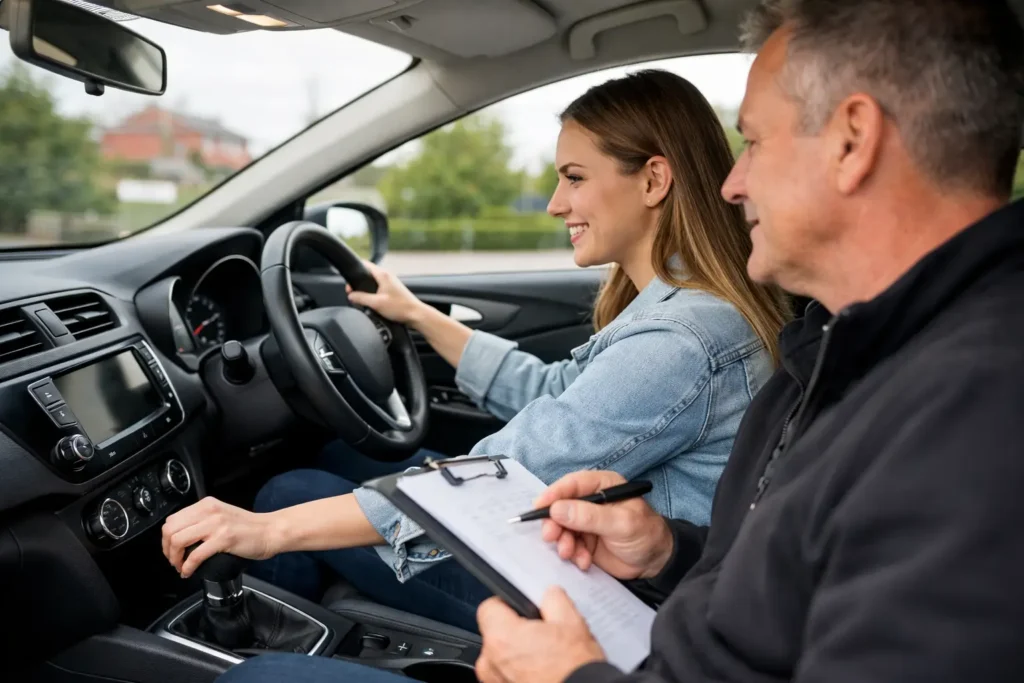
A dependable driving school will also keep lessons one-to-one and taught in a dual-controlled car. That gives learners the chance to stay fully involved throughout the lesson while knowing the instructor can step in if needed. It is a safer, calmer way to learn, especially when you are dealing with new situations.
The parts of manual driving that learners worry about most
Most people do not book their first lesson worrying about parallel parking. They worry about stalling. They worry about rolling back on a hill. They worry about holding people up at traffic lights and feeling judged.
That is completely normal. Manual driving has a steeper learning curve at the start, and the first few lessons can feel busy. Your feet and hands are doing more, and you are trying to read the road at the same time. The right instructor will not brush that off. They will break things down, repeat them when needed and help you improve without making you feel rushed.
Hill starts are a common sticking point in Wakefield because some routes naturally bring gradients into your lessons. But hill starts are not about bravery – they are about method. Once you understand clutch bite, brake control and timing, they become much more manageable.
Stalling is similar. It feels dramatic when it happens, but it is usually just part of learning clutch control. What matters is learning how to recover safely and why it happened, so it becomes less frequent over time. Good manual tuition turns those frustrating moments into progress, not embarrassment.
How many lessons will you need?
There is no honest fixed number. Some learners pick up manual driving quickly and progress at a steady pace. Others need more time to become consistent, especially if they are naturally anxious or cannot fit in regular private practice.
What matters more than chasing a number is building the right standard. Passing the test is important, but being safe and confident afterwards matters more. If you are only just scraping through mock tests, you may not yet be ready for the pressure of driving alone.
Regular weekly lessons usually work well because they give you time to absorb what you have learned without leaving long gaps. Intensive courses can suit some pupils too, particularly if they already have some experience and want to progress quickly. It depends on your confidence, your schedule and how well you retain new skills.
The value of learning with a local, qualified instructor
When you are choosing manual driving lessons in Wakefield, price matters, but it should not be the only thing you compare. A cheaper lesson is not better value if progress is slow, teaching is inconsistent or you are left confused after every session.
Qualified instructors bring more than basic knowledge of the Highway Code. They know how to teach different types of learner, how to manage nerves, how to spot patterns in mistakes and how to adjust lessons without losing momentum. They also know the local roads well enough to introduce difficulty in a sensible order.
That local knowledge helps. An instructor who understands the common pressure points around Wakefield can prepare you properly for them instead of saving them for the last minute. You want lessons that build familiarity with the kinds of junctions, traffic flow and road layouts you are likely to meet on test and after you pass.
English School of Motoring focuses on exactly that balance – affordable, structured tuition with qualified instructors, clear progress monitoring and a strong emphasis on becoming a safe, capable driver for the long term.
Getting the best from your lessons
Learners often think progress depends only on natural ability. In reality, consistency and attitude make a big difference. Turning up on time, asking questions, reflecting on feedback and booking lessons regularly all help you improve faster.
If you can get private practice with a suitable supervising driver, that can be useful too, but only if it supports what you are being taught. Mixed messages can slow learners down. It is usually better to practise a few key skills properly than to spend hours reinforcing bad habits.
It also helps to think beyond the test. A good instructor will teach you how to deal with pressure, not just how to complete manoeuvres in the right order. Real driving is not a scripted routine. It is changing conditions, unpredictable road users and split-second judgement. The more your lessons reflect that, the better prepared you will be.
Signs you may be ready for your practical test
Readiness is about consistency, not one good lesson. If you can drive safely on different routes, make decisions without heavy prompting and recover calmly from small mistakes, you are getting close. You should also be comfortable with independent driving, manoeuvres and meeting varied traffic conditions.
A responsible instructor will tell you honestly whether your standard is there. That might not always be what you want to hear in the moment, but it is far better than sitting a test too early, paying again and taking a knock to your confidence.
When manual might not be the best fit
Manual is a strong option, but it is not automatically the right one for every learner. If coordination is proving a major barrier, or if repeated clutch and gear issues are stopping you from developing road awareness, automatic lessons may suit you better. The goal is safe, confident driving, not forcing one route because it feels more traditional.
Still, many learners who struggle early on in a manual car go on to pass well once teaching is patient and structured. A shaky start does not mean you cannot do it. It usually means you need the right support, the right pace and enough repetition to make each skill feel normal.
Choosing manual lessons is really about future flexibility, confidence and value. With the right instructor, you are not just learning how to move a car through the gears. You are learning how to stay calm in traffic, make safe decisions and take responsibility on the road – and that is what stays with you long after the test day is over.