
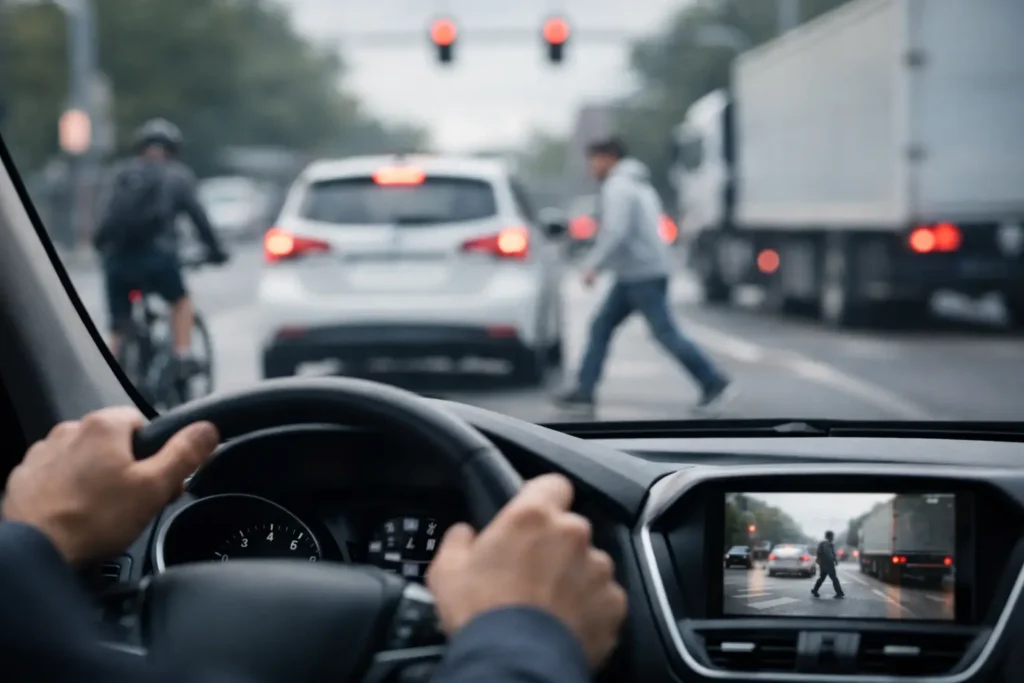
You can know the Highway Code, revise road signs, and still come unstuck on theory test day if you do not understand what is hazard perception test and what the examiners are really looking for. This part of the theory test is not about catching you out. It is about showing that you can spot trouble developing early, which is exactly what safe driving for life depends on.
For learner drivers, the hazard perception section often feels harder than the multiple-choice questions because it is based on judgement and timing. You are watching clips, reading the road ahead, and deciding when a situation changes from normal driving into something that needs your attention. That can feel pressured at first, but once you understand the logic behind it, the test makes far more sense.
What is hazard perception test and why does it matter?
The hazard perception test is the video-based section of the UK theory test. You watch a series of driving clips filmed from the driver’s point of view and click when you see a developing hazard.
A hazard is anything that could make you change speed, direction, or position on the road. A developing hazard is one that is starting to become a problem. That distinction matters. The test is not asking whether you can see everything on the road. It is checking whether you can recognise the moment when a possible risk becomes something you need to respond to.
That is why this part of the test matters so much. Real driving is full of situations that are not dangerous at first, but can become dangerous quickly. A child standing on the pavement may be fine one second and running into the road the next. A parked car is not automatically a hazard, but it becomes one if a door starts to open or it begins to pull out. Good drivers do not just react late. They read the signs early.
How the hazard perception test works
You will watch a set number of video clips on a computer screen. Each clip contains at least one developing hazard, and one clip includes two. As you watch, you click the mouse as soon as you spot a developing hazard.
The score is based on how early you identify it. The earlier you click within the scoring window, the more points you can receive. Each hazard is scored from five down to zero. If you click too early, before the hazard is actually developing, or too late, after the key moment has passed, you may score low or get nothing for that hazard.
There is a catch that worries many learners. Clicking too much in a pattern, or repeatedly without judgement, can be marked as cheating and the clip may score zero. So this is not a game of clicking everywhere just in case. Calm observation beats panic every time.
What counts as a developing hazard?
This is where many people lose marks. They see something that could become a problem, click immediately, and then wonder why they scored nothing. The issue is usually timing.
A developing hazard is not just something you notice. It is something that is beginning to make the driver take action. For example, a cyclist ahead is not automatically a developing hazard simply because they are there. But if the road narrows, traffic approaches, or the cyclist starts moving around a parked vehicle, that situation is developing and may require you to slow down or change position.
The same applies to junctions, pedestrians, buses, parked cars, animals, weather conditions, and vehicles reversing or turning. The road is full of potential hazards. The test rewards you for recognising when one of them is becoming active.
Common examples learners should watch for
In practice, developing hazards often involve movement, uncertainty, or restricted space. A pedestrian near a zebra crossing may step out. A vehicle at a side road may edge forwards. Brake lights ahead may suggest traffic is slowing. A bend with poor visibility may hide an obstruction. A bus stopped at the kerb may mean passengers crossing the road.
It also helps to look beyond the obvious object itself. Ask what might happen next. A football near the road matters because a child may follow it. A driver signalling does not just mean a car is turning. It may mean your lane, speed, or road position needs to change as a result.
This is one reason professional lessons help. During driving lessons, your instructor is training your eyes as much as your hands and feet. The better you get at reading the road in real time, the easier hazard perception becomes on screen.
Why learners find it difficult
Hazard perception is difficult because it sits between theory and real driving. It is not pure knowledge, and it is not fully hands-on either. You need awareness, anticipation, and restraint.
Some learners click too late because they wait until the danger is obvious. Others click too early because they are anxious about missing something. Some focus only on the centre of the screen and miss what is building at the edges, such as pedestrians, side roads, or vehicles approaching from behind.
There is also the pressure of the test itself. If you do badly on one clip, it is easy to carry that frustration into the next. That is why practice matters. The more familiar the format becomes, the less likely you are to second-guess yourself.
How to improve your score
The best way to improve is to stop treating the clips like a memory test and start treating them like a real drive. Scan well ahead, check mirrors and side roads visually, and think about what could change. If something makes you think, “I might need to react to that,” you are usually in the right territory.
A useful technique is the two-click approach, used carefully. If you spot a hazard beginning to develop, click once. If the situation continues to worsen a moment later, click again naturally. This can help with timing without slipping into random clicking. What you must avoid is tapping repeatedly in a set rhythm, because that can trigger the anti-cheating system.
Practice clips are worth using, but quality matters more than quantity. Do not just repeat clips until you remember the answers. Use them to understand why a hazard develops when it does. That is the skill that carries into your actual test and then onto the road.
Practical habits that help before test day
If your theory test is coming up, revise hazard perception in short sessions rather than cramming. Fifteen focused minutes can be more effective than an hour of tired guessing. Watch clips with full attention and then review where you clicked too soon or too late.
It also helps to connect your lesson experience to the test. Think about situations your instructor has talked you through – emerging vehicles, hidden junctions, cyclists, school zones, poor weather, and lane changes. Hazard perception is easier when you realise it reflects normal driving decisions, not tricks on a screen.
If you are learning in busy places such as Leeds, Bradford, Newcastle or Sunderland, you may already be seeing how quickly road situations develop in traffic. That can be a real advantage, provided you use it to sharpen observation rather than increase nerves.
What happens if you fail?
Failing the hazard perception section does not mean you will be a poor driver. It usually means your timing, confidence, or understanding of the format needs work. Plenty of safe drivers need another attempt.
The sensible response is to identify the issue. If you scored low across most clips, you may need to improve general hazard awareness. If you only just missed the pass mark, your timing may be slightly off rather than fundamentally wrong. That is fixable with targeted practice and proper support.
For many learners, combining theory preparation with structured driving lessons is the most effective route. At English School of Motoring, we see that pupils progress faster when they understand not just how to pass, but why road awareness matters in everyday driving.
What is hazard perception test really measuring?
At its core, the test measures anticipation. It is checking whether you can read the road ahead and spot risk before it forces a sudden reaction. That matters far beyond test day.
Drivers who notice hazards early tend to brake more smoothly, choose better road position, and give themselves more time to make safe decisions. They are less likely to be caught out by impatient drivers, hidden pedestrians, changing traffic flow, or poor road conditions. In other words, hazard perception is not an extra box to tick. It is one of the foundations of safe, confident driving.
If you approach it that way, the test becomes less intimidating. You are not trying to beat a computer. You are learning to see the road like a responsible driver, and that is a skill worth carrying with you long after the theory test is done.