A roundabout can feel like several driving tasks arriving at once: signs, lane markings, mirrors, traffic from the right, cyclists, pedestrians and cars behind you. The right roundabout driving techniques turn that pressure into a clear routine. You do not need to rush, guess or copy the car in front. You need time, observation and a safe plan.
For learner drivers, roundabouts are often where confidence starts to grow. They ask you to combine the skills you have already learned – clutch control or smooth automatic control, steering, road position and good observation – in a real traffic situation. With structured practice, they become far more predictable.
Start planning well before the roundabout
The biggest mistake at a roundabout usually happens before you reach it. Leaving decisions until the last few metres can lead to late braking, sudden lane changes or missed exits. As soon as you see the roundabout warning sign, reduce your speed gradually and look for the direction sign.
Read the sign before you are close enough to need the lane. Work out whether you are turning left, going ahead, turning right or taking a later exit. On unfamiliar routes, it is perfectly acceptable to take a little longer to process the information. Safety matters more than proving you know the route.
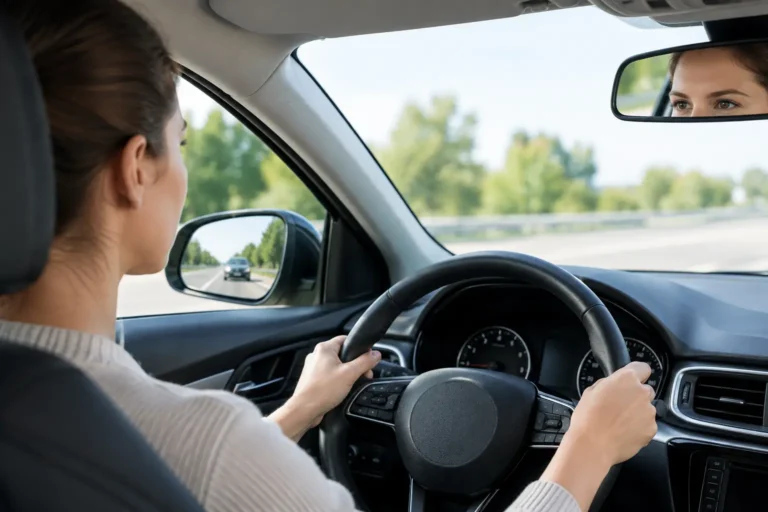
Use the MSPSL routine: mirrors, signal, position, speed and look. It gives you an order to follow when there is a lot happening. Check your mirrors early, signal if appropriate, move into the correct lane in good time, choose a controlled speed and then look properly for traffic as you approach the give-way line.
Choose the correct lane, but read the road too
A common rule is left lane for left turns and straight ahead, right lane for right turns and later exits. However, roundabouts vary. Signs, road markings and lane arrows always take priority over a rule of thumb.
Some larger roundabouts have two lanes for ahead, dedicated lanes for particular exits, or lane markings that change after the entry. In busy town and city locations, road layout can be more complex than learners expect. Look at the markings on the approach, then keep checking them as you travel around.
If you find yourself in the wrong lane, do not cut across another vehicle or make a last-second correction. Continue safely around the roundabout and take the next suitable exit. You may need to go around again. That is not a failure – it is a safe response to an imperfect approach.
Signalling clearly
Signal left when taking the first exit. For a right turn or a later exit, signal right on approach, usually from the right-hand lane where markings allow. When you pass the exit before the one you intend to take, check your mirrors and signal left to show that you are leaving.
For many straight-ahead exits, no signal is needed on approach unless signs or lane markings say otherwise. You should still signal left after passing the exit before yours. Clear, timely signals help other road users understand what you are doing, but never rely on another driver’s signal alone. People sometimes leave indicators on by mistake or signal too early.
Approach slowly enough to see properly
Good roundabout driving is not about finding the fastest gap. It is about arriving at a speed that lets you assess the traffic and stop smoothly if necessary. Select a suitable gear before the give-way line in a manual car, often second gear for a clear, open approach and first gear when you are likely to stop. In an automatic, control your speed with gentle braking and be ready to pause.
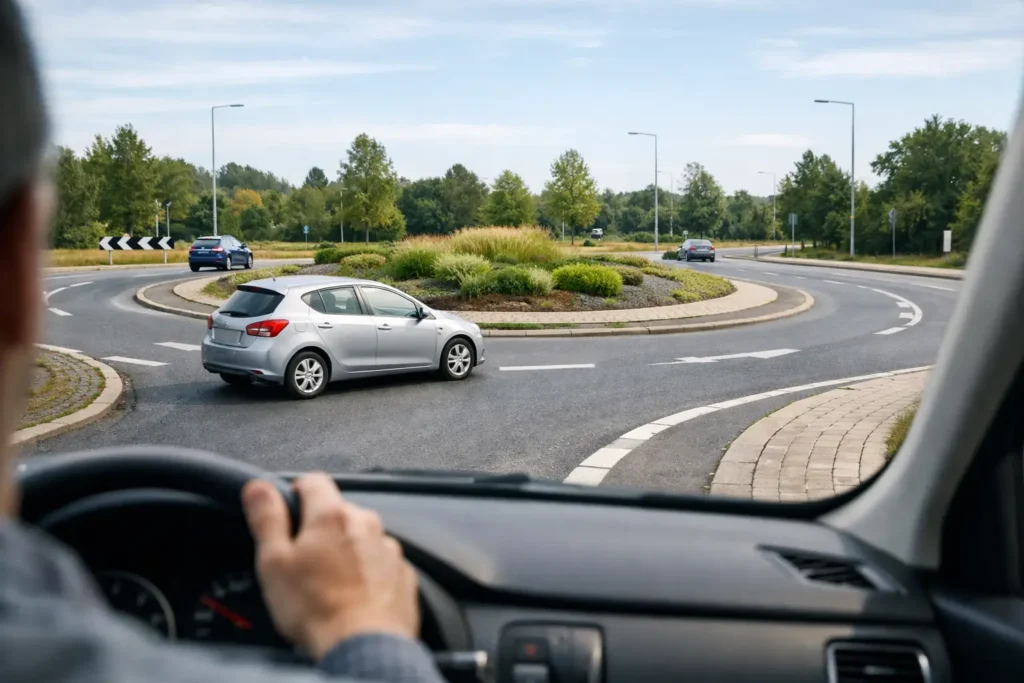
As you approach, look to the right for vehicles already on the roundabout. They normally have priority. Also look ahead for vehicles leaving the roundabout, because a safe gap may appear as they turn off. At mini-roundabouts, remember that the painted central circle is still part of the junction. Give way to traffic from the right and drive around it where practical, rather than cutting straight across it.
Do not stare at one vehicle and miss everything else. Keep your observation moving: right, ahead, right again. On multi-lane roundabouts, assess which lane approaching vehicles are using and where they are likely to go. A vehicle positioned in the inside lane may leave at the first exit, but it may also continue around, so wait until its movement is clear.
Judge gaps without being pressured
A safe gap is one that gives you enough time to enter without making another road user brake, swerve or change speed. If you are unsure, wait. A driver behind may be impatient, but their frustration must not decide when you move.
Learners sometimes pull out because a vehicle is indicating left. Wait for evidence that it is actually leaving: its speed reduces, its position moves towards the exit and its wheels begin to turn. This is especially important at large roundabouts, where an early signal can be misleading.
When the gap is there, move positively. Hesitating halfway into the junction can create more risk than a controlled, confident entry. Bring the clutch up smoothly in a manual car, use enough acceleration to join the traffic flow and keep your steering steady. Positive does not mean fast. It means decisive and controlled.
Keep your position on the roundabout
Once you have entered, stay in your lane unless road markings direct you to move. Avoid drifting wide, particularly when the road bends. Look well ahead towards the exit you need, not down at the kerb or bonnet. Your hands tend to guide the car towards where your eyes are focused.
Check mirrors before changing lanes or exiting. The left mirror deserves particular attention before leaving a roundabout, especially in areas with cycle lanes or busy traffic. A cyclist may be continuing ahead on your left while you are preparing to exit. Give them room and never turn across their path.
Large vehicles need extra patience. Buses and lorries may need more than one lane to negotiate a tight roundabout. Keep back rather than trying to squeeze alongside. You will lose a few seconds, but you avoid being in a blind spot or trapped by a vehicle’s turning path.
Roundabout driving techniques for difficult conditions
Wet roads, darkness and heavy traffic change the way a roundabout should be approached. Braking distances increase in rain, road markings can be harder to see and headlights may make it difficult to judge speed. Slow down earlier and give yourself more space.
In stop-start traffic, do not enter the roundabout unless there is room to clear it. Blocking the exits can quickly create congestion and may leave you exposed to traffic joining from other directions. Keep a sensible gap from the vehicle in front so you can see the road surface, read lane markings and react smoothly.
At a spiral roundabout, follow the painted lanes rather than trying to memorise the entire layout. The lanes are designed to guide you towards the appropriate exit. Read each sign, look ahead and avoid changing lanes unless it is clearly safe. Your instructor can help you build this skill gradually, starting with quieter roundabouts before moving on to more demanding routes.
Practise with a clear goal
Confidence does not usually come from tackling the busiest roundabout repeatedly without a plan. It comes from progressive practice. Start by watching how traffic moves at a quieter roundabout, then practise left turns, ahead exits and right turns separately. Once those routines feel settled, move on to dual-lane and spiral layouts.
A qualified instructor can spot habits that are difficult to notice yourself, such as braking too late, looking only right, missing lane arrows or signalling at the wrong point. At English School of Motoring, lessons are structured around your progress, so you can practise roundabouts at a pace that builds skill rather than simply increasing pressure.
If a roundabout has unsettled you before, do not avoid it forever. Return with a plan, take your time on the approach and let safe decisions become familiar. Every calm, well-observed attempt is another step towards driving confidently for life.