

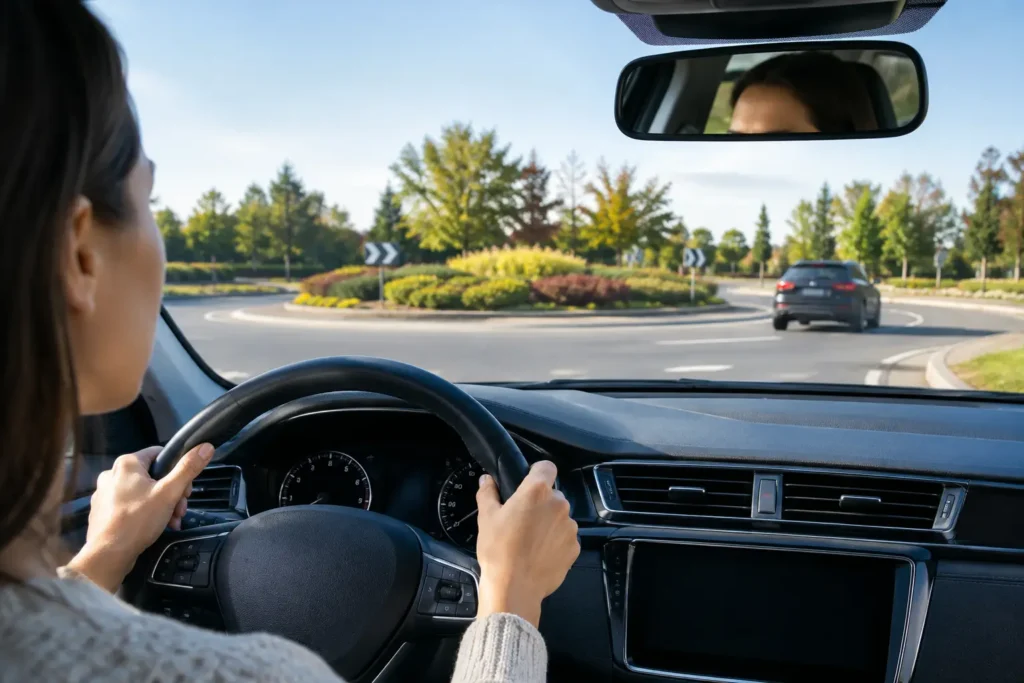
A roundabout can feel like several driving decisions arriving at once: road signs, lane markings, traffic from the right, mirrors, signals and the pressure of cars behind you. Learning how to navigate roundabouts is not about rushing to find a gap. It is about planning early, reading the junction and making each decision in the right order.
For learner drivers, roundabouts are often where confidence starts to grow. Once you understand the routine, even larger roundabouts become manageable. Your instructor will help you practise progressively, starting with quiet mini-roundabouts before moving onto busier multi-lane junctions.
How to navigate roundabouts step by step
The most reliable routine is MSPSL: Mirrors, Signal, Position, Speed, Look. Use it early enough to give yourself time, rather than trying to complete every action at the last moment.
As you approach, look for the roundabout sign and any lane-direction signs. These tell you where each lane leads and may show the exit you need. Check your interior mirror, then the appropriate door mirror, signal if needed, and move into the correct lane while it is still safe to do so.
Slow down smoothly. Most roundabouts require a low approach speed so you can assess traffic and stop if necessary. Select a suitable gear before reaching the give-way line. In a manual car this is often second gear, although first may be needed at a tight, busy or uphill junction. In an automatic, ease off early and let the car slow under control rather than braking sharply at the line.
At the give-way line, look to the right for traffic already on the roundabout. You must give way to it. Also check ahead for vehicles leaving the roundabout, as they may create a safe opportunity to join. Do not pull out just because another driver flashes their lights or appears to slow down – make your own judgement based on what you can clearly see.
When there is a safe gap, move onto the roundabout with steady control. Keep looking ahead towards your chosen exit, while remaining aware of traffic around you. Avoid staring at the kerb, the central island or the car in front. Your steering naturally follows where your eyes are looking.
Choosing the correct lane and signal
The lane and signal you use depend on your exit, the signs and the road markings. The Highway Code gives the general approach, but signs at a particular roundabout always take priority.
For a left exit, normally take the left lane and signal left on approach. This is usually the first exit, although on some layouts it may not be. Follow the arrows and signs rather than relying only on the number of exits.
For an exit to the right, or for turning back on yourself, normally approach in the right-hand lane and signal right. Keep that signal on as you enter. Once you have passed the exit before your own, check your mirrors and signal left to show that you are leaving.
For an exit straight ahead, you will usually approach without signalling. Your lane may be left or right depending on the markings, particularly at larger roundabouts. After passing the exit before yours, check mirrors and signal left before you leave.
The key point is that a signal should help other road users understand what you intend to do. Do not signal too early for an exit before your own, and do not forget the left signal when leaving. A clear, well-timed signal can make the roundabout safer for drivers, cyclists, motorcyclists and pedestrians alike.
Use the road markings, not assumptions
Many learner drivers assume the left lane always means left or straight ahead, and the right lane always means right. That is often true on simple roundabouts, but it is not a rule you can rely on everywhere.
On busy routes around Newcastle, Sunderland, Leeds or Bradford, lane arrows may direct each lane to specific exits. Some roundabouts have spiral markings that guide you across lanes as you travel around. Others have traffic lights or filter lanes. Read the signs well before the junction, get into position early and stay in your lane unless the markings direct you otherwise.
If you realise you are in the wrong lane, do not make a sudden lane change or cut across another vehicle. Continue safely around the roundabout and take an alternative route. Taking the wrong exit is far safer than making a risky correction.
Judging a safe gap
A safe gap is not just an empty space. You need enough time to pull out, build speed and join the traffic flow without making another driver brake sharply or change direction. The size of the gap depends on the speed of approaching traffic, the power of your car, the weather, visibility and the design of the roundabout.
Look for the speed and position of vehicles coming from the right. A car that appears distant can reach you quickly on a fast approach road. Large vehicles need particular care: lorries and buses may use more than one lane and can obscure your view. Give them plenty of room and never try to squeeze alongside them.
On a busy roundabout, be patient. Keep the clutch controlled if you are waiting in a manual car, but avoid creeping forward beyond the give-way line unless you are certain it is safe. If traffic is heavy, there will be another gap. A few extra seconds is never worth a collision.
Mini-roundabouts need the same care
Mini-roundabouts are small, but they still follow the same give-way rule. Treat the painted central circle as if it were a physical island: drive around it clockwise and give way to traffic from the right.
Because visibility can be limited, approach slowly and be prepared to stop. On very tight residential roads, cars may straddle the painted circle where necessary, but only when it is safe and no other road user is affected. Do not drive straight over it as though it is not there.
Dealing with cyclists, pedestrians and motorcyclists
Roundabouts are shared spaces, so your observations must go beyond other cars. Cyclists may keep to the left or, particularly on larger roundabouts, move into a more central road position to avoid being overtaken unsafely. Give them room and never cut across their path when leaving.
Motorcyclists can be harder to spot and may be hidden in a blind spot. Check mirrors carefully before changing lane or exiting. Pedestrians may be waiting at crossings on the exit road, especially where the crossing is close to the roundabout. As you leave, keep your speed low enough to stop safely if required.
Common roundabout mistakes to avoid
Most roundabout errors come from a lack of planning rather than a lack of ability. Approaching too quickly makes it harder to read signs, choose a gear and judge traffic. Leaving signals too late gives other road users less information. Focusing only on the right can mean missing a cyclist beside you or a pedestrian at the exit.
Another common mistake is following the vehicle in front without checking for yourself. The driver ahead may be taking a different exit, may hesitate unexpectedly, or may have made an error. Keep a sensible gap and make your own observations.
During a practical driving test, examiners are not looking for perfection at every junction. They want to see safe observation, sensible speed, correct positioning and good judgement. If you take a wrong exit but remain safe and controlled, that does not automatically mean you have failed.
Build confidence through practice
Roundabout confidence is built in stages. Start with a route you know, practise your approach routine and talk through the signs with your instructor. Then progress to different layouts, heavier traffic and unfamiliar roads. Repetition helps the process become natural, leaving you more attention for changing traffic conditions.
At English School of Motoring, qualified instructors use structured, one-to-one lessons to help pupils build the judgement and calm control needed for real driving, not simply the test route. Whether you are learning in the North East or Yorkshire, regular practice with clear feedback can turn roundabouts from a source of worry into a routine part of every journey.
The next time you see a roundabout ahead, give yourself time: read the signs, slow down, look properly and let a safe gap come to you. Calm, planned driving is the confidence that lasts.