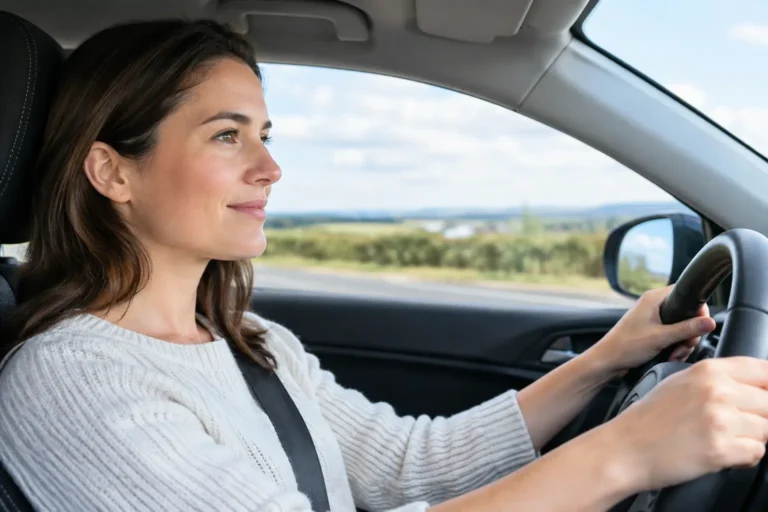
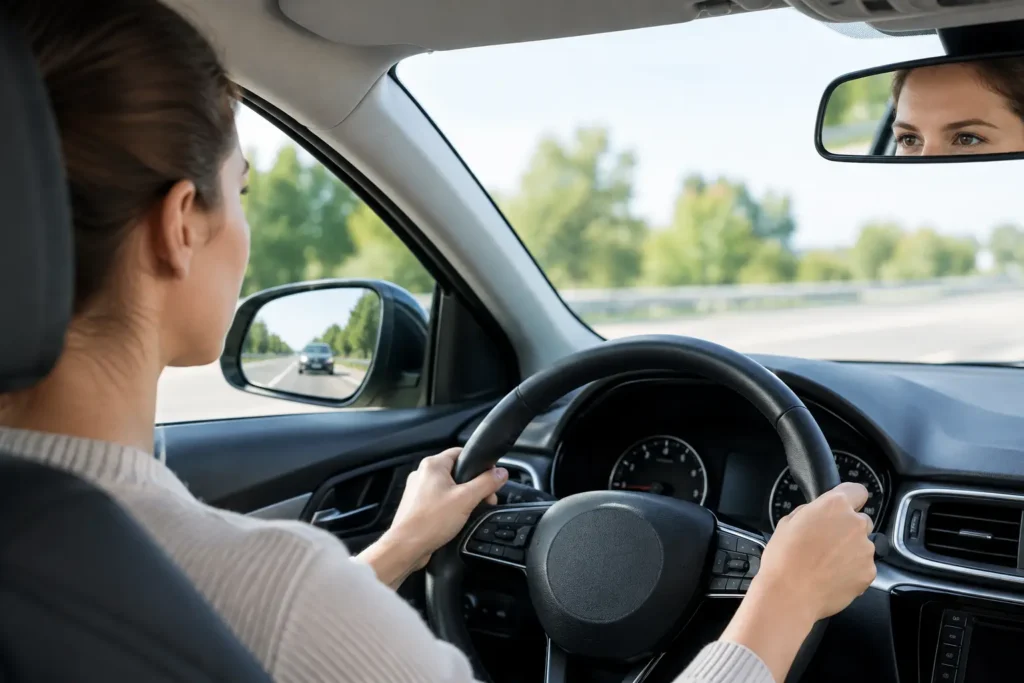
A missed mirror check can turn a routine turn, lane change or stop into a risky moment. Learning how to improve mirror checks is not about making obvious head movements for the examiner. It is about building a reliable habit of knowing what is behind and alongside you before your car changes speed or position.
For learner drivers, mirrors can feel like one more thing to remember while steering, judging gears, reading signs and watching other traffic. With the right routine, though, checks become a natural part of every drive. You will feel more in control, make calmer decisions and show your instructor and examiner that you are aware of the road around you.
Why mirror checks matter on every journey
Your mirrors give you information that the windscreen cannot. Before you slow down, turn, move away, change lanes or overtake, traffic behind may need to react. A cyclist may be approaching on your left. A motorcyclist may be filtering through slow traffic. Another driver may have started to overtake just as you plan to turn.
Good mirror use helps you spot these situations early enough to adjust safely. Sometimes the correct response is simply to continue with your planned manoeuvre. Other times, you may need to wait, reduce speed more gradually or abandon the manoeuvre until it is safe. That judgement is what safe driving is about.
On the practical driving test, the examiner will be looking for timely, purposeful observation. They do not expect you to stare at mirrors constantly. They do expect you to check them before your actions could affect another road user.
Start with correctly adjusted mirrors
You cannot use mirrors well if they are set badly. Set them before moving off, when the car is parked and secure. Your interior mirror should give you a clear view through the rear window, with as much of the window as possible visible. Avoid pointing it too far down at the back seats or too much towards one side.
Your door mirrors should show a small amount of the side of your own car and a wide view of the road behind. If too much of your vehicle fills the mirror, your view of nearby traffic is reduced. If you cannot see any of the car at all, it can be harder to judge where vehicles are in relation to you.
Different cars have different mirror shapes and viewing angles. If you are driving a new vehicle, take a moment to get comfortable with its layout. A qualified instructor will help you find a safe setting, but it is a useful habit to understand for yourself.
Use a simple mirror routine
The most useful routine for learners is often described as Mirrors, Signal, Position, Speed, Look. It reminds you to gather information before acting, rather than checking after you have already started the manoeuvre.
For most changes of direction or speed, check the interior mirror first. This tells you how close following traffic is and whether someone behind may need extra warning. Then check the relevant door mirror. If you are turning left, look in the left mirror. If you are turning right, check the right mirror.
The order matters because it gives you a quick picture of both the traffic directly behind and the traffic near the side of the car. Then signal, where appropriate, and continue to assess the road ahead as you position and adjust your speed.
There is no need to pause for a long time on each mirror. A short, clear glance is enough. Your eyes must return to the road ahead quickly, especially on busy roads or when travelling at speed. Good mirror checks are frequent, deliberate and balanced with effective forward observation.
Check before changing speed
Many learners remember mirrors before turns but forget them before braking. Every time you slow down noticeably, check the interior mirror first. This includes approaching a queue of traffic, a red traffic light, a pedestrian crossing, a roundabout or a hazard in the road.
The check helps you judge whether the driver behind is close or not paying attention. You should still brake safely when needed, but knowing what is behind lets you brake progressively where possible and reduces the chance of surprising another driver.
You do not need a mirror check for every tiny lift of the accelerator. Think about whether your reduction in speed could affect traffic behind you. If it could, check.
Check before changing direction or road position
Use mirrors before turning at junctions, moving around parked vehicles, changing lanes, joining a dual carriageway and leaving a roundabout. The same applies when moving towards the kerb to pull up or when pulling away again.
When passing parked cars, your position may need to move right to leave a safe gap. Before doing so, check the interior and right mirror. On a narrow road, you may also need to wait for oncoming traffic rather than forcing your way through. Mirror checks support that decision, but they do not replace looking ahead and reading the whole situation.
At roundabouts, plan early. Check mirrors before slowing down and again before signalling to leave, particularly if your position is changing. Avoid treating this as a fixed script. The traffic level, lane markings, exits and nearby cyclists will affect what you need to observe.
Do not forget blind-spot checks
Mirrors cannot show everything. The areas that remain hidden are called blind spots. You must look over the appropriate shoulder when moving off from the side of the road, pulling away after stopping in traffic, changing lanes, or moving from a lay-by or parking bay.
A blind-spot check is particularly important for cyclists, motorcyclists and pedestrians. On a left-side move, glance over your left shoulder. On a right-side move, glance over your right shoulder. Keep it brief and only do it when your car is under control and the road ahead is safe to look away from for that moment.
For example, when moving off from the left, use the full routine: interior mirror, right mirror, left mirror where relevant, blind-spot check, signal if necessary, then move only when it is safe. Your instructor may teach the order slightly differently for a particular situation, but the principle remains the same: observe all areas that could contain a hazard.
How to improve mirror checks in driving lessons
The fastest way to improve is to connect each check to a reason. Rather than telling yourself, “I need to look in the mirror,” ask, “Who could be affected by what I am about to do?” That question makes mirror use meaningful instead of mechanical.
Try talking through your observations during part of a lesson. You might say, “Interior mirror clear, left mirror clear, slowing for the junction.” This commentary approach can feel awkward at first, but it reveals missed checks and helps your instructor correct timing. Once the routine is established, you will not need to say it aloud.
It also helps to practise one situation at a time. Spend time on approaching junctions, then pulling up on the left, then moving off again. Repeating the same sequence on quieter roads builds the habit before you need it in heavier traffic around Leeds, Bradford, Newcastle or Sunderland.
Ask your instructor for direct feedback. Are you checking too late? Looking for too long? Missing the relevant door mirror? Qualified instruction and progress tracking give you a clear picture of what to work on, rather than leaving you to guess.
Common mirror-check mistakes to avoid
One common mistake is checking mirrors only when prompted. On the test and after you pass, nobody will remind you. The goal is for the check to happen automatically before the manoeuvre begins.
Another is looking at a mirror without processing what is there. A glance is not useful if you have not noticed the cyclist, close-following car or vehicle beginning to overtake. Build the habit of briefly registering distance, speed and road position.
Some learners exaggerate their mirror movements because they want the examiner to see them. Your checks should be visible, but they should also be natural. Small head and eye movements are usually enough. Keeping your attention away from the road ahead for too long creates a new risk.
Finally, do not assume a clear mirror means it is safe to move. Mirrors are one part of effective observation. Use them alongside forward planning, blind-spot checks where needed, signals, safe speed and good positioning.
Build confidence beyond the practical test
Mirror checks become even more valuable once you are driving independently. Roads change quickly: a child on a bike can appear beside you, traffic can close up behind you, and an unfamiliar junction can require a last-minute change of plan. A quick check gives you the information to stay calm and choose the safer option.
At English School of Motoring, our structured lessons focus on habits that last beyond test day. Whether you are learning from the beginning, preparing for an intensive course or building experience through Pass Plus, regular practice with an experienced instructor can make safe observation feel second nature.
On your next drive, choose one key habit to focus on: check the interior mirror before every clear reduction in speed. Once that feels natural, add the relevant door mirror before each change of direction. Small, consistent improvements are how confident, safe drivers are made.